
The Vigenère cipher: three centuries as the “indecipherable cipher”
How the Vigenère cipher works — actually devised by the Italian Giovan Battista Bellaso: the table, the keyword, a step-by-step example, the maths, the Kasiski method that broke it and an exercise.

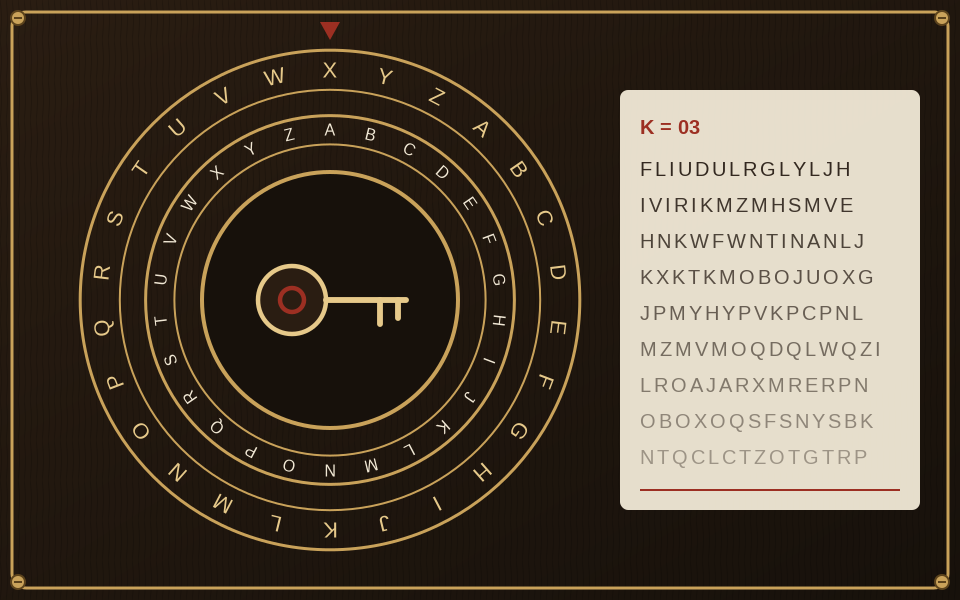
The Caesar cipher shifts every letter by the same number of positions: trying 25 shifts is enough to break it. The Vigenère cipher takes a decisive step: it uses a keyword and shifts each letter by a different amount, according to the corresponding letter of the key. So the same letter of the message becomes, at different points, different letters.
For about three centuries it was considered unbreakable: in France it was called le chiffre indéchiffrable, the indecipherable cipher. It bears the name of the French diplomat Blaise de Vigenère, but it was first described in 1553 by an Italian, Giovan Battista Bellaso. It was broken in the nineteenth century with a method that is still a classic of cryptanalysis.
The idea in brief
- Polyalphabetic
- It uses several cipher alphabets, alternating them according to the key, instead of just one.
- Keyword
- A word agreed between sender and recipient, repeated along the message.
- Square table
- A table with 26 rows, each an alphabet shifted one position further.
- Weakness
- The key repeats: whoever discovers its length reduces the problem to many Caesar ciphers.
The Vigenère cipher descends from the ideas of the Alberti cipher disk and paves the way for rotor machines such as Enigma; how it is broken is studied with the Kasiski examination.
The pages of this topic
Vigenère cipher: history
From Alberti to Trithemius, from Bellaso to Vigenère: how the “indecipherable” cipher was born, why it bears the wrong name and how it was broken in the nineteenth century.
Vigenère cipher: how it works
How to encrypt and decrypt with the Vigenère cipher using the square table and the repeated keyword.
Vigenère cipher: worked example
Step-by-step encryption of the message “meet me at the bridge” with the key CIPHER, letter by letter.
Vigenère cipher: the maths
The formulas of the Vigenère cipher in modular arithmetic, the key space and why the repetition of the key is its weakness.
Vigenère cipher: weaknesses and attacks
The Kasiski method, Friedman’s index of coincidence and column-by-column frequency analysis: how the Vigenère cipher is broken.
The Vigenère cipher today
Where the Vigenère cipher is found today: teaching, games, puzzles, and the lessons it left to modern cryptography.
Vigenère cipher: try it yourself
Encryption and decryption exercises with the Vigenère cipher, with solutions.
Vigenère cipher: frequently asked questions
Short answers to the most common questions about the Vigenère cipher.
More topics in this section
Caesar cipher
The most famous cipher of antiquity: how the three-letter shift works, why it breaks in seconds and what it still teaches today.
9 pages
The Spartan scytale
What the Spartan scytale was, how transposition ciphers work, what the ancient sources really say, how it is broken and what remains of it in modern cryptography. With examples and exercises.
9 pages
Enigma
How Enigma, the German cipher machine of the Second World War, worked, why it was believed unbreakable and how Polish and British mathematicians managed to read its messages.
9 pages