
The Spartan scytale: the staff that hid messages by moving letters around
What the Spartan scytale was, how transposition ciphers work, what the ancient sources really say, how it is broken and what remains of it in modern cryptography. With examples and exercises.

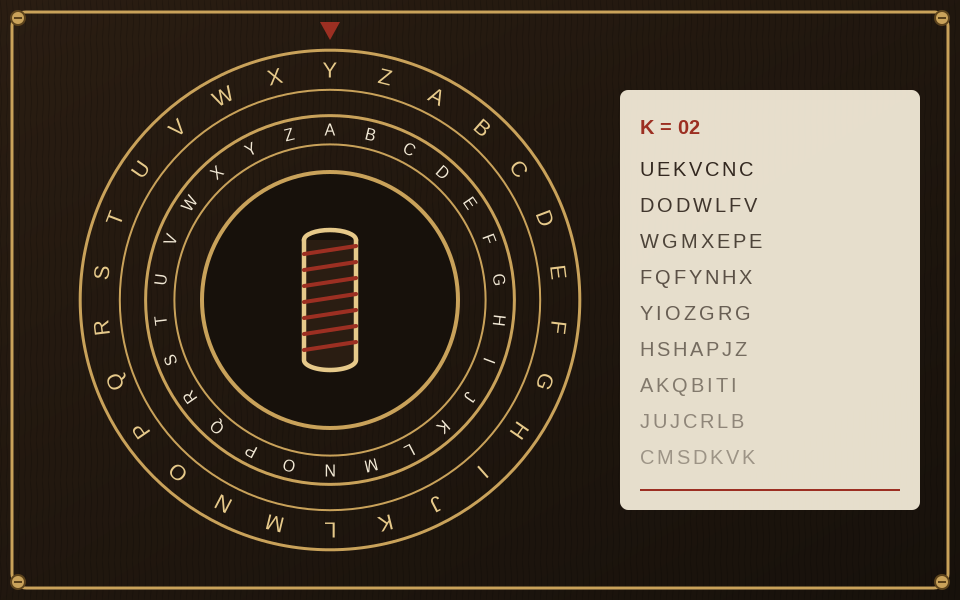
A leather strip wound in a spiral around a staff. On it, a message written along the staff, row after row. Unwound, the strip shows only a line of meaningless letters: to read it you must wind it again around a staff of the same thickness. This is the scytale, the device the ancients attributed to the Spartans and which many textbooks present as the first military cryptographic device in history.
The scytale is the oldest and most intuitive example of a transposition cipher: the letters of the message stay the same, but change places. It is the opposite of the Caesar cipher, which replaces each letter with another while leaving it in place. The two ideas — substitution and transposition — are still the two basic building blocks of modern ciphers.
In short
- What it is
- A staff around which a strip is wound: you write along the staff, unwind, send.
- Type of cipher
- A transposition: the letters stay the same, their order changes.
- The key
- The diameter of the staff, i.e. how many letters fit in one turn of the strip.
- The weakness
- There are very few possible keys and they can all be tried in minutes.
The scytale predates the Vigenère cipher and the Enigma machine by centuries, but the principle of transposition survives in today’s cryptography.
The pages of this topic
The scytale: history
The ancient sources on the scytale, from Archilochus to Thucydides and Plutarch, the story of Lysander and the modern debate on its real use.
The scytale: how it works
How the scytale works step by step: winding the strip, writing along the staff, unwinding and reading with a staff of the same diameter.
The scytale: worked example
Encrypting the message ATTACKATDAWN with a three-row scytale, and decrypting it step by step.
The scytale: the maths
The scytale as a permutation of positions, the formula that moves each letter, the number of possible keys and why letter frequencies do not change.
The scytale: weaknesses and attacks
How a scytale is broken: trying every diameter, anagramming, clues from frequencies and the physical weaknesses of the device.
The scytale today
What remains of transposition in cryptography: 20th-century military ciphers, double transposition, diffusion in modern block ciphers.
The scytale: try it yourself
Exercises to encrypt and decrypt with the scytale, find the unknown diameter and build a paper scytale, with solutions.
The scytale: frequently asked questions
Short answers to the most common questions about the Spartan scytale.
More topics in this section
Caesar cipher
The most famous cipher of antiquity: how the three-letter shift works, why it breaks in seconds and what it still teaches today.
9 pages
Vigenère cipher
How the Vigenère cipher works — actually devised by the Italian Giovan Battista Bellaso: the table, the keyword, a step-by-step example, the maths, the Kasiski method that broke it and an exercise.
9 pages
Enigma
How Enigma, the German cipher machine of the Second World War, worked, why it was believed unbreakable and how Polish and British mathematicians managed to read its messages.
9 pages